


Data Centers & Real Estate: The Hottest Conversation in US Housing: What CT Homeowners Should Know
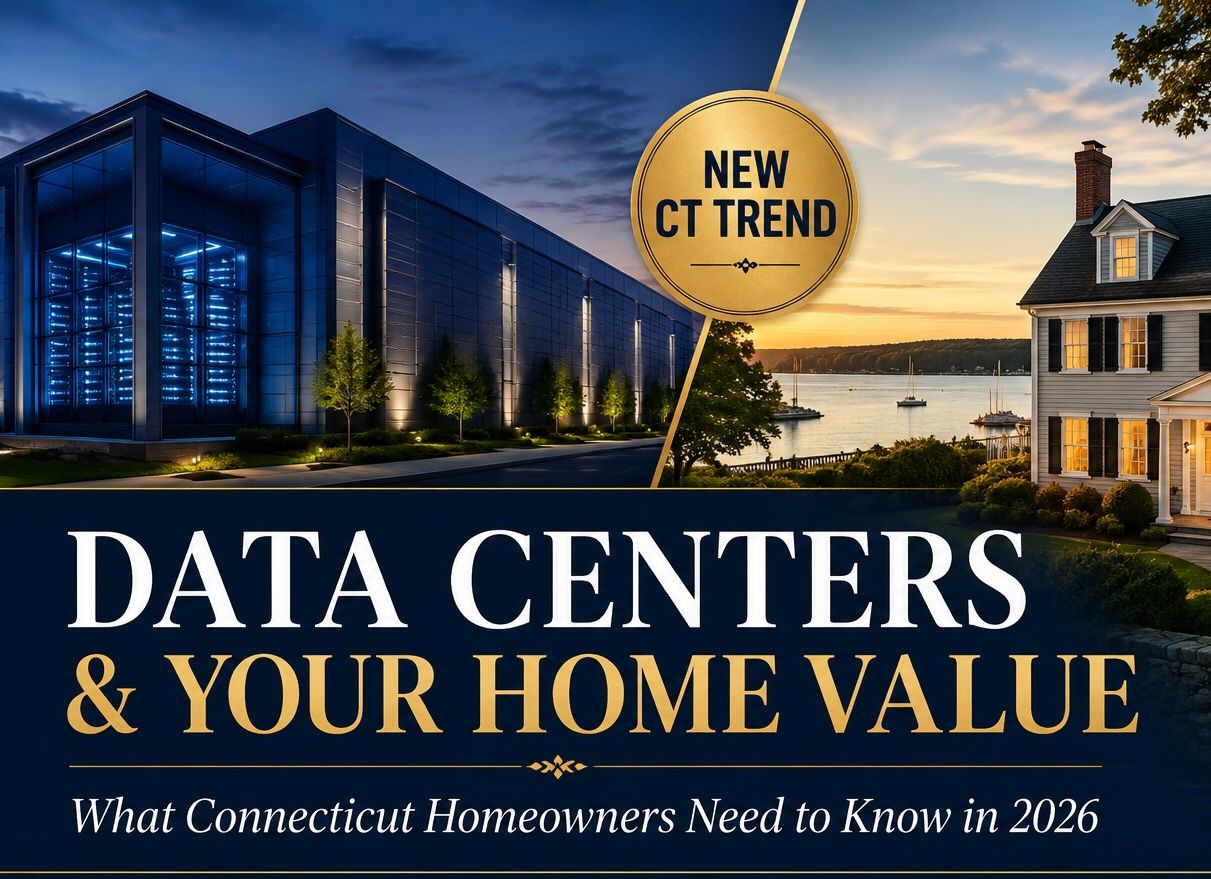
Data centers are being built at a pace that would have seemed impossible five years ago, they are arriving in residential neighborhoods that never anticipated them, and the effects on property values, utility bills, and community character are genuinely complex. Christina Chorna, CT Realtor, has been following this story closely — because it is not an abstract national trend. It is already arriving in Connecticut.
The AI Building Boom Nobody Saw Coming
Every time someone asks ChatGPT a question, streams a Netflix series, stores a photo in the cloud, or asks a voice assistant for the weather — a data center somewhere processes that request. And the demand for that kind of computing power is growing at a rate that has sent the entire real estate industry into a new conversation it was not fully prepared for.
According to JLL's 2026 Global Data Center Market Outlook, roughly 100 gigawatts of new data center capacity is expected to come online between 2026 and 2030, representing $1.2 trillion in real estate asset value creation. The global data center sector is growing at a 14% compound annual rate. The Federal Reserve Board expects investments in U.S. data centers to reach an annualized rate of $370 billion by the second quarter of 2026. By 2030, companies worldwide are expected to invest nearly $7 trillion in building and upgrading data centers.
That is not a niche technology story. That is one of the largest real estate investment cycles in modern American history — and it is reshaping neighborhoods, driving zoning battles, and creating questions that agents like Christina Chorna are fielding from clients who are starting to notice what's going up down the street.
Scale Check: There are currently 11,038 data centers globally across 174 countries. Nearly 40% of them are in the United States. Demand is projected to nearly triple by 2030. CoStar projects data center completions will rise from 33.5 million square feet in 2025 to 76.1 million square feet in 2026 alone — more than double in a single year.
What Actually Is a Data Center — And Why Are They Showing Up Next to Neighborhoods?
A data center, at its most basic, is a facility that houses computer servers, networking equipment, and data storage systems. These buildings are typically large, windowless, heavily secured, and require enormous amounts of electricity and water for cooling. A standard data center covers about 100,000 square feet. A hyperscale data center — the kind being built by Google, Meta, Microsoft, and Amazon — can cover up to 10 million square feet.
So why are they suddenly appearing near residential areas? Three reasons: the AI boom has supercharged demand for computing power, available land in established tech corridors like Northern Virginia has grown scarce and expensive, and developers are actively scouting new locations — including suburban and semi-rural markets — that offer land availability, grid access, and favorable tax treatment.
Per Inman's June 2026 analysis, real estate professionals are navigating a world where data center expansion is moving faster than the zoning codes — and buyers and sellers are showing up to transactions with questions that didn't exist ten months ago. The city of Reno, Nevada recently became the first local government to pause new data center applications entirely while it works out regulations. Other cities are watching.
The Big Question: Do Data Centers Help or Hurt Property Values?
The honest answer — and Christina Chorna appreciates an honest answer — is: it depends on proximity, and the research is more nuanced than the headlines suggest.
The Academic Evidence: Closer Can Mean Higher
A 2025 analysis by the Center for Regional Analysis at George Mason University examined BrightMLS home sales against data center locations across Northern Virginia — the country's largest data center hub, known as 'Data Center Alley.' The finding was counterintuitive: homes closer to data centers sold for more, not less, while those farther away fetched less.
The explanation offered by researchers: data centers tend to locate in areas that already have strong infrastructure — reliable utilities, good roads, proximity to jobs and airports — and those same factors independently make neighborhoods more desirable to buyers. As real estate broker Erik Leland observed: "The data centers did not create the desirability. They locate where it already exists."
In New Albany, Ohio — where Meta, Google, and Amazon all have data centers — a luxury advisor at Sotheby's International Realty reported that demand and property values have surged meaningfully over the past five years.
The Resident Reality: Immediate Neighbors Tell a Different Story
The academic data covers regional trends. The experience of people living directly adjacent to data centers is more complicated. According to Newsweek's reporting, residents near large facilities have raised concerns about:
- Noise: Cooling fans and backup generators operate continuously — and in some cases, 24 hours a day. One resident reported having to move a newborn baby to the basement due to vibrations and sound.
- Lighting: Security lighting at large facilities can affect nearby homes around the clock.
- Electricity rates: Data centers consume massive amounts of power. Communities with heavy data center concentrations have seen upward pressure on electricity costs for residential ratepayers.
- Water use: Cooling systems require significant water draw — a growing concern in areas facing drought or utility constraints.
- Visual impact: Large, windowless, industrial-scale buildings affect neighborhood character and street-level aesthetics in ways that other commercial development does not.
As Inman notes: "Being regionally near a data center and being immediately adjacent to one tend to have opposite effects on value." That distinction — regional vs. immediately adjacent — is the key variable.
The Rule of Thumb: Research and on-the-ground agent experience consistently point to the same conclusion: being 5–10 miles from a data center may bring economic benefits (jobs, tax revenue, infrastructure upgrades). Being directly next door to one brings genuine quality-of-life considerations that buyers should evaluate carefully.
The Tax Revenue Upside
One of the most compelling economic arguments for data centers near residential communities is their tax profile. Per CBRE's 2026 U.S. Real Estate Market Outlook, in Loudoun County, Virginia — the heart of Data Center Alley — data centers will contribute nearly half of all local property tax revenue in 2026. The key characteristic that makes this extraordinary: data centers pay significant property taxes but require almost no municipal services — no school enrollments, no extra police patrols, no parks and recreation. They are, from a municipal finance perspective, nearly ideal tax contributors.
This tax dynamic has a direct effect on residential homeowners: it can allow municipalities to reduce residential property taxes, fund infrastructure improvements, or invest in community amenities — all factors that independently support property values.
Connecticut Specifically: What's Actually Happening in Our State
Connecticut homeowners and buyers might be tempted to file data centers under "someone else's problem." They would be filing incorrectly.
Connecticut Has 59 Data Centers — and More Are Coming
According to Data Center Dynamics, Connecticut already has 59 data centers, with the majority concentrated in Norwich. And that number is growing fast:
- Atlas Capital Group is pursuing development of a one-million-square-foot data center in Bloomfield, north of Hartford — on a 44-acre former tobacco field. The proposal was presented to Bloomfield's Town Plan and Zoning Commission, where it is in early conceptual stages.
- 365 Data Centers has identified Trumbull, in Fairfield County, as one of four additional markets nationally where it is pursuing letters of intent for data center development — alongside Louisville, Harrisonburg, and other markets.
For buyers and homeowners in Fairfield County and the Hartford region, this is no longer a hypothetical. It is an active development story worth tracking.
Connecticut's Policy Battle Is Underway
Connecticut is actively wrestling with how to regulate this growth. Per WSHU Public Radio's reporting, the state legislature's Energy and Technology Committee held public hearings in early 2026 on Senate Bill 245, which would revoke tax incentives for data centers that Governor Lamont signed into law in 2021. Those incentives allow qualifying data centers to forgo state taxes on property and other fees.
The Office of Consumer Council raised concerns about how data centers might affect ratepayer costs and electricity reliability — a direct quality-of-life issue for Connecticut homeowners whose utility bills could be affected by large industrial energy draws on the regional grid.
CT Homeowner Takeaway: Connecticut is in the early innings of a policy conversation that will determine how data centers are regulated, where they can be built, and who pays for the energy they consume. Homeowners in Fairfield County and the Hartford region in particular should watch these developments — and buyers should ask about zoning and planned developments as part of due diligence on any property.
What Connecticut Buyers and Sellers Should Actually Do About This
Christina Chorna's approach to questions about data centers is the same as her approach to any environmental or development question: research, disclose, and contextualize. Here's what that means in practice:
For Buyers
- Ask about industrial and commercial permits near any property — not just data centers. A quick search of municipal zoning filings can reveal what is planned for nearby parcels before an offer is submitted.
- Distinguish between "near" and "adjacent." A data center five miles away in an industrial corridor is a different conversation than one proposed for the adjacent parcel. The research confirms these have meaningfully different effects.
- Research the specific facility type — a small colocation center and a hyperscale AI training campus are not the same thing. Size, operator, power draw, and noise profile vary enormously.
- Check Connecticut's data center incentive landscape — the tax policy debate in Hartford may affect which projects get built and where.
For Sellers
- Disclosure matters more than avoidance — if a data center is proposed or under construction near a listing, proactive, factual disclosure positions a seller as trustworthy and avoids complications at closing.
- Context is everything — the regional economic benefits (jobs, tax revenue, infrastructure investment) are legitimate counterweights to proximity concerns, and a well-informed seller can present both sides accurately.
- Price accordingly and honestly — if a property is immediately adjacent to a data center, buyers will research it. Pricing reflects reality. Attempting to obscure it reflects poorly and rarely succeeds in Connecticut's current market.
For Investors
The "halo zone" investment thesis — buying residential real estate 5–10 miles from a new data center campus before the surrounding market prices in the economic activity — is a real strategy being discussed among sophisticated real estate investors in 2026. Trumbull and Bloomfield, Connecticut are now on that map. Whether this plays out the way it has in Northern Virginia and New Albany, Ohio remains to be seen — but Christina Chorna is watching it closely.
The Bottom Line: Data Centers Are a Real Estate Story Now 🔌
The AI boom is not an abstract technology story. It is a physical infrastructure story — one that is being built on real land, in real communities, with real effects on the people who live nearby. Connecticut is already home to 59 data centers, has two significant new facilities in early development stages, and is actively legislating how this growth will be managed going forward.
Christina Chorna's job — like that of every good local real estate professional — is to make sure buyers and sellers have accurate, contextualized information about what is happening in the communities where they are making one of the biggest financial decisions of their lives. Data centers are now part of that conversation. And the agents who understand the nuance will serve their clients far better than those who simply say "don't worry about it" or "it will destroy your home's value" — because neither of those answers is supported by the evidence.
The reality, as always in real estate, is more interesting than the headline. And Christina Chorna is always happy to talk through what it means for a specific address, a specific neighborhood, and a specific set of goals.
Questions About Your Connecticut Home or a Property You're Considering?
Whether the question involves data centers, market conditions, Fairfield County homes, or simply what the Connecticut real estate market looks like right now — Christina Chorna is the local expert who gives honest, research-backed answers.
Start the conversation at: www.ctrealtorchristina.com
Categories
Recent Posts









GET MORE INFORMATION